
Protecting the reefs in Mauritius
We sometimes get a request for a Discover Scuba Diving session on Coin de Mire Island. This trip we took an important businesswoman scuba diving to Coin de Mire Island, expecting to wow her with the shoals of fish and spectacular variety of rare fishlife, together with stunning corals. We were wrong. Coin de Mire has been fished out. No big shoals, not much variety, and plenty of algea, coral rubble and dead corals. Why?
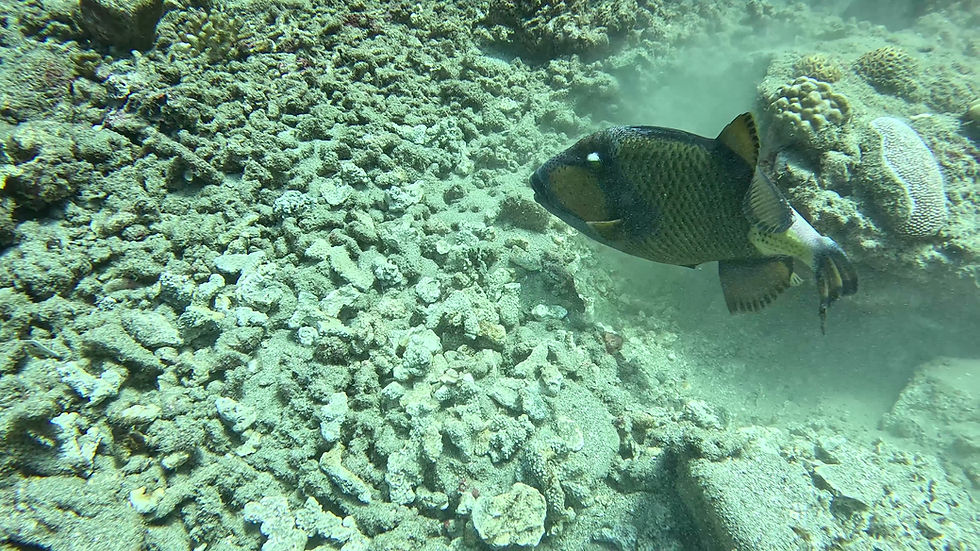
This Titan Trigger fish excavated a 1 metre by 500 cm hole to find a clam and left hungry
This year has seen significant reductions in the marine life around Mauritius. The Gulf Stream (AMOK) has slowed, and there are some theories promoting the concept of a geological shift in magnetic north to account for this. Certainly this year there has been no upwelling of cold water from the Southern Ocean with the accompanying plankton surge, and there are no huge shoals of fish that follow the bounty of plankton. This means there is no food source for the marine predators who have left our barren waters to hunt where thir food sources can be found.
The Caribbean experienced a massive dumping of sargassum, and this alone has affected the food source for young fish. https://www.theguardian.com/world/2025/jun/03/caribbean-sargassum-seaweed

Massive dump of sargassum in the Caribbean Photo source PBS.
We had a few whisps of sargassum in Mauritius, but fortunately it stayed in the ocean.
Fish only hatch when there is a food source, and there have been fewer fish hatching. Those that do hatch must be rigorously protected. The Fisheries and Marine Resources Protection Act of 2023 is the primary resource for the protection of our reefs and our marine world.Objectives of Act are primarily to ensure the long-term conservation, management and development of fisheries and aquaculture in Mauritius while safeguarding the marine resources, biodiversity, environment and ecosystems for the benefit of the people of Mauritius. The Ministry of The Blue Economy has a wonderful champion in the Deputy Minister Fabrice David who has proudly stood up and declared his intention to protect the ocean. And that starts with the reefs.
The official notice of protection has been issued has been issued by the National Coast Guard. This enforces the ban on net fishing that prevails in Mauritius from November 2025 to March 2025

The Mauritius Coast Guard does a great job of protecting the reefs.
Net fishing is illegal from 31 October to 1 March, and the Ministry has issued dire warning of increased fines for transgressors. The Ministry of Blue Economy and the Mauritius Coast Guard work in tandem to protect our marine resources.

Barkha Mossae with Deputy Minister of Fisheries and The Blue Economy the Hon Fabrice David.
He is a champion of ocean protection, and publicly embraces scuba diving as a blue economy resource This is a huge paradigm shift in Mauritian government policy. Scuba diving was previously regarded as a recreation. Now, the contribution of in excess of Rs 6 billion to the Mauritian Economy in 2020 means that this can be embraced by the ministry of the Blue Economy as an activity with serious potential, and a financial contribution to the Mauritian economy that out-strips fishing ten fold.
.
He understands the need to enfirce protection of the reefs, and preservation of our unique species of marine life. While he indicates his support for legal fishermen with government licences he recommends that they cannot ignore restrictions on fishing. There are no licences for the collection and capture of reef fish.
Mauritians love their ocean and they love their marine life. The comercial fishermen I have spoke to are desperate to find a better less controversial means of making a living. They would embrace a better career as a marine guide, showing tourists their wonderful world. This is a dream for many fishermen who endure a tough livelihood. They rise at 4 am, push the motor of the boat engine to the beach, get wet in the lagoons fishing for bait where tourists despise them, then spend all day laying long lines, hauling in dead fish then returning at 4 pm to sell a catch that gets smaller every year..
The fishermen I have spoken to feel very strongly that the jobs they do pay minimunm wage and are very hard work. They would far prefer to become Marine guides, using their knowledge of the ocean and its creatures as marine travel guides.

Inimicus Filamentosus photographed by Ian Haggerty.The contribution to the Mauritian economy of a single Inimicus filamentosus far exceeds the value of a net full of baby lagoon hatchlings
Our own dive master Bernard, is a prime example of this. He spent his early years as a fisherman assistant on the Dhabeda, and qualified a skipper as soon as he could afford to train. Now he is one of our most knowlegeable Ocean Spirit Scuba diving leaders.
Our important client loved her Discover Scuba Diving experience. She did a second dive, and is now hooked on scuba diving. She starts training in March! How much better to hook divers, than to hook our diminishing schools of fish!
Links
Ocean Spirit Scuba Divingosdiving.com
Ocean Spirit Mauriitusfacebook.com/oceanspiritdiving
Ocean_Spirit_Diving_Centreinstagram.com/divingmauritius
Ocean Spirit Scuba Divingyoutube.com/@oceandivermu
Ocean Spirit is a PADI Eco diving centre with a PADI Green Star. We dive in clear blue water 9 months of the year, with rays, turtles, shoals occasional sharks and whales and dolphins. Its fabolous, its fun and its great vlaue for new divers. The scuba diving industry fits perfectly into the Mauritius Tourism offering. Mauritius has a unique advantage for diver training. • Shallow lagoons • Safe reefs close to shore • Blue water • White sand • Colourful soft corals • Only the Gili Island in Indonesia has such an offering, and they are top in the world for Padi Training


Me pareció muy interesante este artículo porque presenta la información de una manera clara y sencilla. Estaba buscando información sobre loteria nacional y encontré aquí detalles útiles para comprender mejor el tema. Este contenido resulta práctico para quienes desean mantenerse informados y consultar información relacionada con la lotería de forma rápida y organizada.
mình có lần lướt đọc mấy trao đổi trên mạng شيخ روحاني thì thấy nhắc nên cũng tò mò mở ra xem thử cho biết. mình không tìm hiểu sâu chỉ xem qua trong thời gian ngắn để quan sát bố cục cách sắp xếp جلب الحبيب các mục và trình bày nội جلب الحبيب dung tổng thể. cảm giác là các phần được trình bày khá gọn, các hurentest berlin mục rõ ràng Huren Berlin nên đọc lướt cũng không bị rối với mình như vậy là đủ để nắm tin cơ bản rồi. جلب الحبيب
👍
Very insightful and supportive message for families. Saving helpful videos with an instagram reel downloader allows me to revisit good advice whenever needed.
Trump threatens 91 club login new tariffs on European allies over Greenland until deal reached, as thousands protest
Trump threatens diu win new tariffs on European allies over Greenland until deal reached, as thousands protest